

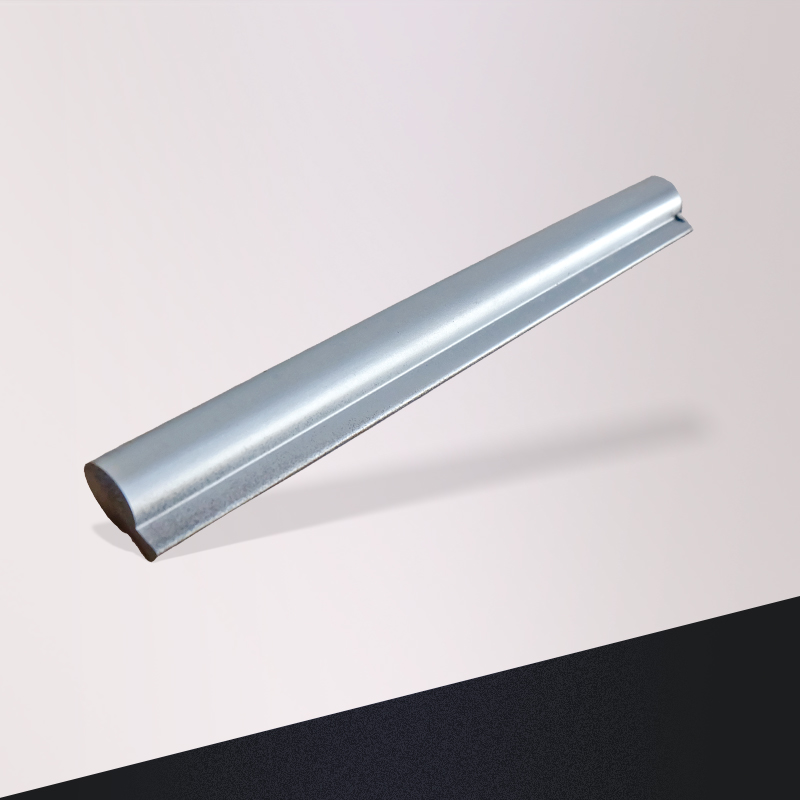
Cold-drawn special-shaped steel for textile machinery fittings is produced by cold drawing forming process. It is a custom cross-section metal profile, and the trapezoidal cross-section shown in the figure is one of the commonly used specifications. After cold drawing, the profile contour fits various special-shaped grooves and positioning structures of textile machines. It can be directly used as blanks for loom accessory machining, eliminating extensive profile milling operations and suiting mass production of textile equipment parts. With stable cross-section and thin surface oxide layer, the profile facilitates secondary processing such as cutting, drilling and welding, supporting fabrication of textile machinery components with various special shapes.
The cold drawing process modifies the internal microstructure of steel and improves its deformation resistance. Components made from it resist twisting under continuous vibration of looms. Cross-sections can be customized per drawings, including trapezoidal, channel and multi-sided special profiles, matching the shape of limit, support and guide parts inside looms. Manufacturers only need partial hole machining to finish the parts, shortening single-piece processing time. Low dimensional variation within the same batch enables continuous feeding for CNC production.
The primary application is complete shuttleless loom manufacturing. Loom frames contain many special-shaped grooves for mounting positioning supports, rail pressure strips and limit stoppers. Components made from this cold-drawn special-shaped steel match the contour of mounting grooves for good fitting during assembly and reduce on-site grinding and adjustment. Sustained vibration occurs during high-speed loom operation, and supports made from the special-shaped steel withstand alternating loads to keep components positioned and cut downtime.
This profile is also widely used for loom technical renovation and maintenance. Many non-standard positioning spare parts for old loom retrofits have no off-the-shelf equivalents. Using cold-drawn special-shaped steel as blanks, replacement parts matching the grooves of old machines can be rapidly fabricated. Maintenance orders are often small with varied cross-section requirements. Cold-drawn special-shaped steel supports small-batch custom production to supply spare parts for renovation projects without separate casting moulds, shortening delivery lead time.
Cold-drawn special-shaped steel is also used for frame pressure strips and positioning parts of auxiliary textile equipment in cotton and chemical fiber weaving workshops. Such equipment runs nonstop year-round, and components endure long-term vibration impact. The mechanical properties of cold-drawn special-shaped steel fit these working conditions. Subsequent heat treatment and electroplating can be applied to boost rust resistance for humid textile workshops.
Cut-to-length supply is available. Profiles are cut according to customer drawings and delivered ready for direct feeding, removing the need for on-site cutting. Different cross-section specifications can be produced in separate batches to meet alternating procurement demands for new loom R&D and spare parts for legacy models. The profiles do not roll easily when stacked and packed, minimizing impact damage during storage and transit and reducing raw material loss.
The wall thickness of cold-drawn special-shaped steel for textile fittings can be adjusted based on component load. Thicker walls are adopted for heavy-load supports while thin-wall options are used for lightweight guides. Small batches can be produced for prototype testing to verify assembly before mass production after finalization. The material features good weldability, delivering stable weld beads that resist cracking during component assembly.
The profile is suitable for manufacturing various textile machinery components, including warp stop frame support strips, rail fasteners, frame limit blocks and fabric feed support bases. After assembly and commissioning on weaving lines, components maintain dimensional stability under long-term vibration and reduce machine failures caused by deformed positioning parts. Flexible raw material stocking accommodates both sporadic small orders and large-volume orders for complete loom supporting parts.

 Phone Number:Panlixin 13706201799 Panliyong 13306238299
 Service Hotline:0512-52468216
 Company Address:Zhangjiaqiao, Xinzhuang Town, Changshu City
 Technical Support:Lange chain enterprise

Enterprise Wechat

Add Wechat
 Ch
 En
 Add wechat
 Contact us
 Telephone